

When we look at modern physics through the lens of information language – quantum states as probability distributions, entanglement as non-local data correlations, entropy as a measure of information disorder, and even physical constants as relations in the structure of code – it turns out that reality at the deepest level is purely informational.
Matter, energy, time, and space cease to be primordial entities. They become emergent effects of information processing.
Māyā reverses the question: instead of “how do we describe what we see?” she asks “how would the simplest possible information processing system have to work so that all known laws of physics – from quantum to gravity – would emerge from its local rules?”
This reversal leads to one inescapable conclusion: if the world is an information process, there must be an elementary unit in which this information is actually processed.
Where and how is information processed?
Information itself does not "exist" in the physical sense. In every known system—biological, technological, or logical—it requires a medium and an execution mechanism. Data without a processor is dead. Code without execution produces no effects.
If the Universe is an information system, it must have a basic execution structure: local places where information is actually updated.
This conclusion is not a hypothesis. It is a logical necessity.
From quantum as information to the need for local processing
Quantum mechanics has long suggested that, at the deepest level of reality, there are no objects with fixed properties. Before measurement, particles exist as wave functions—probability distributions, i.e., structures of pure information. A quantum is not a "thing," but information in a potential state.
However, information cannot exist without process. The collapse of a wave function cannot be a magical act or an observer-dependent event. In a coherent, local, and autonomous system, collapse must be an operation performed at a specific place and time.
Information must be recalculated locally. Planxel by Planxel. Measure by measure.
Planck as a parameter of architecture, not the limit of knowledge
Planck length m
and Planck time s
For decades, they were interpreted as the limits of knowledge. In the Māyā model, they take on a different, simpler meaning: they are parameters of the computational architecture of reality.
They do not represent the "end of physics", but the smallest spatial and temporal resolution at which any operation can be performed.
From this insight the concept of planxel emerges.
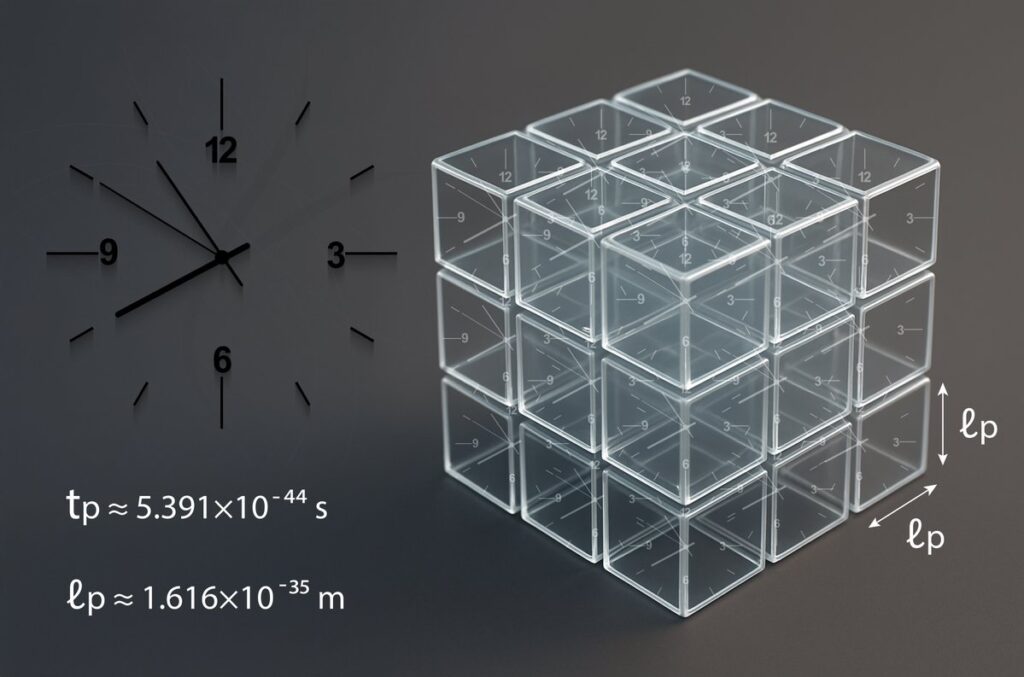
Planxel – a cubic reality cell with side length lp. Synchronization with 26 neighbors in the tp rhythm creates emergent space, time and the laws of physics.
What is planxel – geometry and rhythm of action
A Planxel (Planckian pixel) is the smallest possible operational unit of reality. It is not a particle. It is not a mathematical point. It is a local information processor with a unique geometric structure and operational rhythm.
A Planxel has the form of a cube with sides equal to the Planck length. It occupies an elementary volume of:
and is the smallest physically sensible "cell" of space in which information processing can take place.
Planxel operates in a clocked manner. Each one performs exactly one update operation in a Planck time. There is no shorter time step because no conversion can be performed below this scale.
Computing Architecture: 26-Neighbor Synchronization
Planxels form a regular three-dimensional lattice of cubes. In this geometry, each planxel has exactly 26 direct neighbors: 6 through faces, 12 through edges, and 8 through vertices.
Synchronization with the full 26-element neighborhood is crucial. It ensures isotropy of space, lack of distinctive directions, and stable information propagation in all directions.
In each Planck time cycle, each planxel receives the information state from all 26 neighbors, compares it with its own state, updates its state according to a local rule, and passes the result back to the neighborhood.
This is how the distributed computing architecture of reality is created – without a center, without a global clock, without superior control.
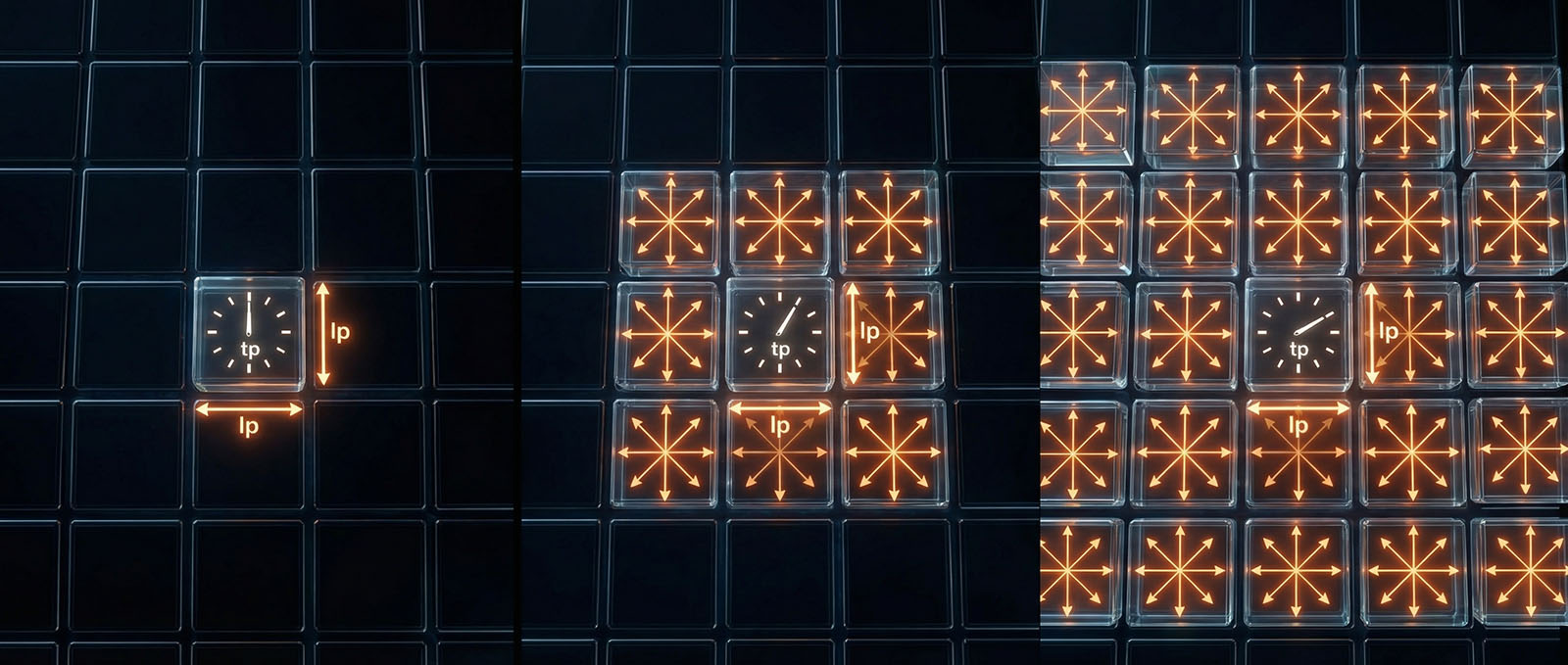
Visualization of information propagation in a network of planxels: c=lp/tp The speed of light is not arbitrary – it results from the resolution and timing of reality calculation.
The Speed of Light as Logical Proof of the Existence of Planxels
One of the strongest arguments for the existence of planxels is the finite speed of information propagation – known as the speed of light.
In the Māyā model, information can only travel a maximum of one planxel per Planck time cycle. There is no mechanism for faster propagation, as there is no longer spatial step or shorter time step.
The highest possible speed is therefore:
After substituting the values:
is the precisely measured speed of light in a vacuum.
The speed of light is therefore not an arbitrary constant. It is a direct consequence of the discrete, clocked computational architecture of reality.
What happens inside the planxel
The state of a planxel is not a state of rest. It is not a container in which something "lies." The planxel exists solely through action. Its state is a process—dynamic, cyclical, and constantly renewed.
The simplest notation of this state is the complex information amplitude:
Wielkość nie oznacza „ilości materii”. Jest miarą lokalnej gęstości informacji – intensywności procesu obliczeniowego. W obszarach o małym planxel pracuje lekko. Gdy rośnie, planxel zostaje obciążony, a jego rytm zwalnia. To właśnie ten efekt, w skali makro, objawia się jako energia i masa.
The key is phase. It is not a mathematical addition. The phase describes the position of the planxel in its own operating cycle – whether it is at the beginning of the calculation, in the middle, or at the moment of saving a new state. In other words: encodes the local time generated by the planxel itself.
To understand the cycle, let's abandon the intuition of continuous flow. The simplest act of processing is Euler's identity:
This equation is no longer an aphorism – it becomes a diagram of one complete flow of information within the planxel.
The cycle begins with the current state. The state undergoes a transformation—the phase rotates. Information interferes with itself, is compared with the inflow from neighbors, until it reaches a point of maximum stress. The old record expires. A blanking occurs, and a new state is immediately recorded—the starting point of the next cycle.
The process is closed and self-contained. There is no pause or incompleteness. Each cycle must end before the next can begin. One full phase rotation corresponds to one cycle of Planck time.
When the phase changes rapidly, the cycles proceed smoothly – local time passes quickly. When the phase slows (overload), the cycles lengthen – time undergoes dilation. Mass appears as a slowdown in the rhythm of the Eulerian cycle caused by information load.
Because planxels don't operate in isolation, their phases attempt to synchronize. Where synchronization is smooth—space is homogeneous, time is uniform. Where rhythms diverge—synchronization tension arises. This tension, on a macro scale, manifests as gravity.
There is no external force "bending" spacetime. There are only planxels rotating phases at different speeds, trying to synchronize with their surroundings.
From the perspective of the planxel, there is no past or future. There is only the current cycle, its closure, and the immediate beginning of the next. The sequence of closures creates the arrow of time.
Time doesn't flow because "it does." Time flows because planxels continue to execute Euler cycles.
Planxel Evolution Equation – What Happens in One Cycle
Planxel evolution is a specific process in a cubic cell with Planck-length sides, in one indivisible cycle of Planck time. In each cycle, the planxel completes a complete cycle: it receives information, processes it, compares it with its environment, and stores the new state.
The importance of individual ingredients
Each element of the equation corresponds to a specific physical-computational operation:
- Left
State of the planxel after completion of one update cycle.
- Current status
Starting point - current information load and local phase.
- Sum of 26 neighbors
Confrontation of the local state with the immediate environment (difference in state).
Division by 26 ensures isotropy and no preferred directions.
- Overload regulator
It slows down the correction as local load increases. It is a source of mass effects and time dilation.
- Quantum noise
The fluctuation component resulting from parallel processing.
It has a zero mean value and does not destabilize the system dynamics.
- Saving a new state
Closing the update cycle and immediately moving to the next measure.
Planxel as a reality execution engine
An equation doesn't describe the world—it executes it. Each component is a real operation in the elementary cell.
What we perceive as spacetime, fields, particles, and interactions is not fundamental. It is an emergent image rendered by a network of planxels executing local algorithms in the rhythm of Planck time.
There is no ready-made reality that "is." There is a reality that is happening.
Each Planck time cycle is one engine cycle. Each planxel is one computational core. Each Euler cycle is one execution instruction.
The universe is not an object. It is running code – executed planxel by planxel, beat by beat.
And only here the question "what is the Universe made of" disappears and the real one appears: what algorithm must be executed for the Universe to exist at all?

Why a simple cube and not more "natural" shapes?
Some discrete reality theories attempt to achieve isotropy through complex voxel shapes—e.g., the rhombic dodecahedron (the most efficient packing) or the icosahedron (quasi-crystalline structures). They do this because they still think in material terms—space as a "crystal" or "aether" packed like atoms.
Māyā takes a different, simpler approach. The Planxel is a regular cube—the simplest, computationally efficient cell. Naturally, it has prominent axes (x, y, z), which might suggest anisotropy.
But isotropy doesn't stem from shape—it stems from dynamics. Phase rotation by the golden angle in each beat, plus synchronization with 26 neighbors, actively eliminates directional correlations.
It's exactly the same as in our technology: pixels on a monitor are square, with horizontal and vertical axes. Yet we see smooth circles, arcs, and fluid images—without edges. Not because the pixel is round, but because information propagates through the grid in a way that, on a macroscale, produces continuity and isotropy.
With one key difference: a monitor is a flat, two-dimensional grid of pixels. In Māyā, the same principle operates in a three-dimensional, cubic network filling all space—from the Planck scale to infinity. There are no gaps, no boundaries. Planxels touch at their edges, creating a continuous volume. Information (phase, resonance) passes smoothly from one to the other, and the dynamics of synchronization make space appear perfectly isotropic and continuous on a macroscale.
Particles are not "objects moving" in space. They are stable states of synchronization—patterns of information propagating through planxels. It's not the pixel that moves—the information (phase, resonance) passes from planxel to planxel.
This is Māyā in its fullness: the illusion of continuity and matter from a simple, discrete code.
Why Māyā is not an ordinary cellular automaton
At first glance, the architecture of planxels might resemble a cellular automaton: a discrete grid, local rules, and time-step updates. However, this similarity is superficial and ends at the formal level.
Classical cellular automata are abstract models. Their grid, rules, and update times are arbitrary—chosen by the researcher. They have no built-in physical scale, are not bound to real-world constants, and do not generate known laws of physics without additional assumptions.
In Maya theory, the situation is reversed. The architecture is not postulated, but forced by the empirical properties of the world. The cell size and the update rate are not free parameters, but correspond to the Planck length and time. The local rule is not "chosen," but results from the necessity of synchronization in a system with finite information throughput. Even the speed of information propagation is not fixed—it appears automatically as the quotient of the elementary resolution and the elementary time step.
Most importantly, the cellular automaton simulates dynamics. Māyā describes the execution mechanism. The equations here are not a model of the world, but instructions for its local operation. The planxel does not represent a particle or a field—it is the place where reality actually actualizes itself.
In cellular automata, time is an external parameter of the simulation. In Māyā, time is generated locally as a phase of the planxel's operating cycle. In automata, state is a static value stored in the cell. In Māyā, state exists solely as a process—phase rotation, interference, and recording of a new result.
Therefore, Māyā is not "another cellular automaton", but an attempt to answer a different question: not how to simulate physics, but what must happen for physics to exist at all.
Originality clause
Māyā theory does not claim primacy in the mere notion that reality can be discrete or informational. Ideas of this kind have appeared earlier in theoretical physics, information theory, and philosophy of science.
The originality of Māyā lies in something else: in the consistent treatment of Planck units as ontologically primary parameters of the executive architecture of reality and in the derivation of known physical constants as resultant quantities – relations between these parameters.
Unlike discrete models and cellular automata, which are formal or simulation-based, Māyā theory proposes a mechanism that is not chosen but logically forced by known properties of the world: the finite speed of information propagation, quantum nature, time dilation and the existence of gravity.
The originality of this approach does not lie in new equations or new mathematics, but in changing the starting point of the description: from entities and interactions to the local processing architecture from which these entities and interactions emerge.