
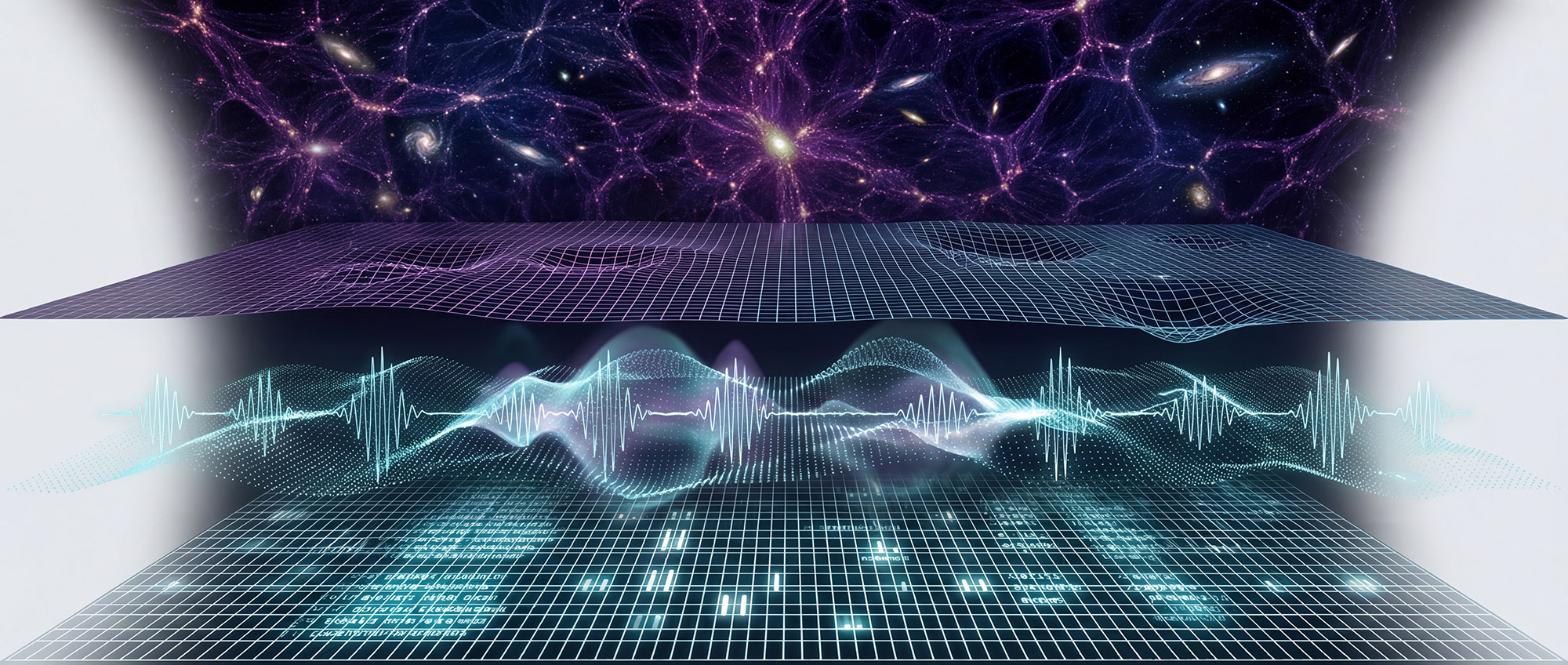

The future is today

Institute for Quantum Reality Studies and Astrophysics – ISKRA

ISKRA FOUNDATION is a place of new ways of understanding the Universe.
We explore the informational nature of reality and we develop an approach in which physics becomes a process based on fundamental units of information.

We focus on ideas of MĀYĀ Code Reality Hypotheses, describing the world as a discrete, rhythmic and computational structure.
Our goal is both to understand this architecture and to create technologies that can result from it.

Welcome to the place where science meets the courage of thought.
Welcome to ISKRA.

The research conducted by ISKRA is fundamental in nature, concerning the fundamental structure of the Universe. Its implications lead to a radical shift in our understanding of reality. In the long term, it may open up bold new directions for technological development.
Your involvement supports: development of the MĀYĀ Code Reality Hypothesis, creation of planxel simulations, research into the informational nature of physics, research on technologies arising from the MĀYĀ theory, publications, model promotion, workshops, and open science.
0 %
compatibility with the formalism of modern physics, while eliminating paradoxes
1 +
Downloads and first recipients of scientific publications of the MĀYĀ Reality Code Theory

It from Bit. MĀYĀ Code Reality Theory points to a new paradigm: the foundation of our reality is information!

The foundations of a new physics paradigm

The Computational Nature of Reality

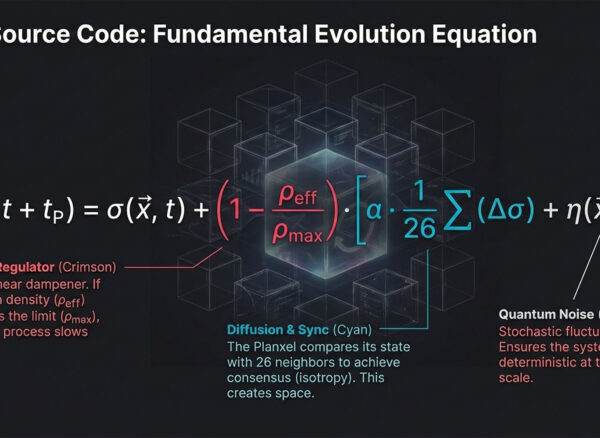
The new perspective posits that space, time, particles, and interactions are not primordial entities, but rather the effects of the discrete, 3D information architecture of the universe. The foundation of this structure is not geometric fields or continuums, but local reality processors, which:

The most fundamental trace of this architecture is the speed of light:
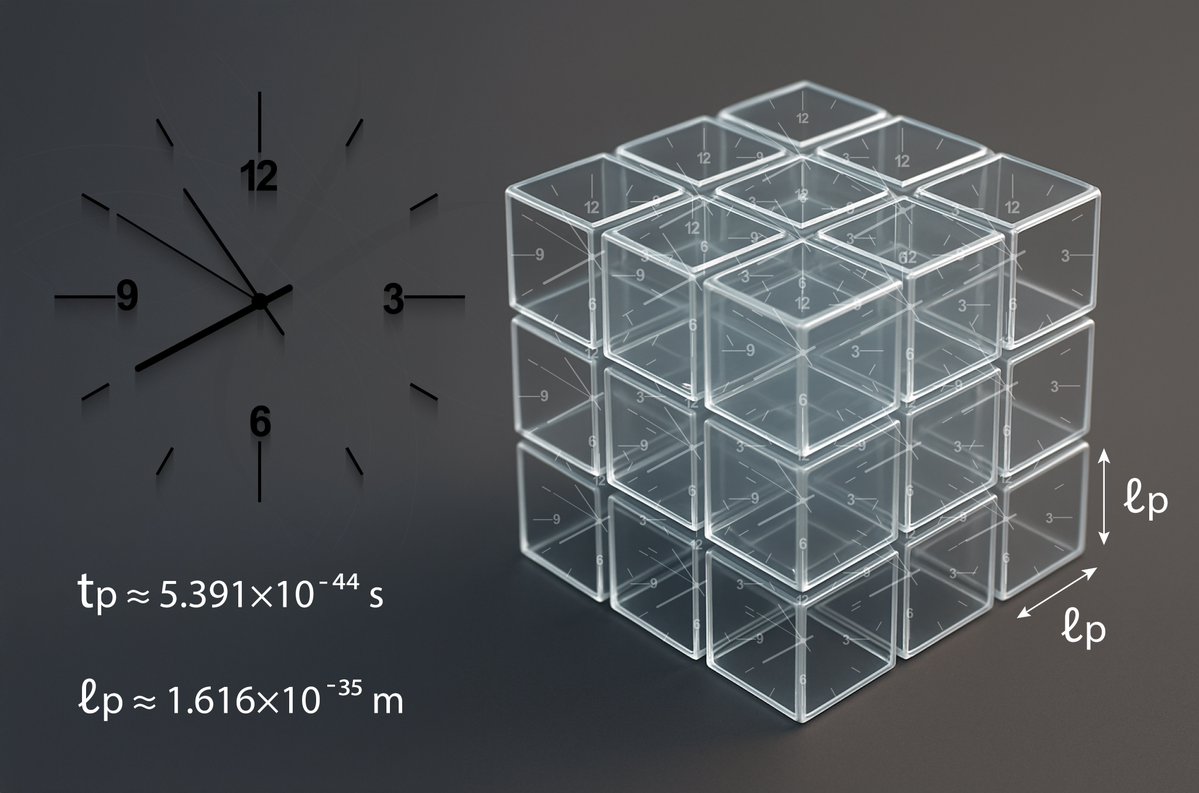
information can move one "Planck pixel" per clock cycle, hence
c = lₚ / tₚ.

In this view, space, motion, and time are not independent entities — they arise from the rhythm of information updating. This reversal of perspective organizes quantum, relativistic, and cosmological phenomena into a single, coherent, computational structure.

All physics emerges from this process of actualization.

The missing piece of the physics puzzle

MĀYĀ theory suggests that the source of many paradoxes in modern physics is the failure to consider the information layer as the foundation of reality. When we reverse the perspective and treat physical constants as a consequence of the operation of computational architecture, known equations begin to reveal mechanisms that had previously remained hidden. Information becomes the missing element that makes quantum, relativistic, and cosmological phenomena cease to be separate entities — they reveal themselves as different levels of a single, informational ontology.

The most powerful example of this shift in perspective? A black hole.
In classical physics, it's a singularity of infinite density.
In the MĀYĀ model, it's a place where the local computational clock of reality extends to infinity.
Not a "hole in spacetime," but a suspension of the information updating process.

Emergent laws of physics

Modern physics is full of "free parameters" whose values ​​do not derive from any underlying mechanism. MĀYĀ interprets these as emergent effects—natural consequences of the way the planxel grid computes and stabilizes information.

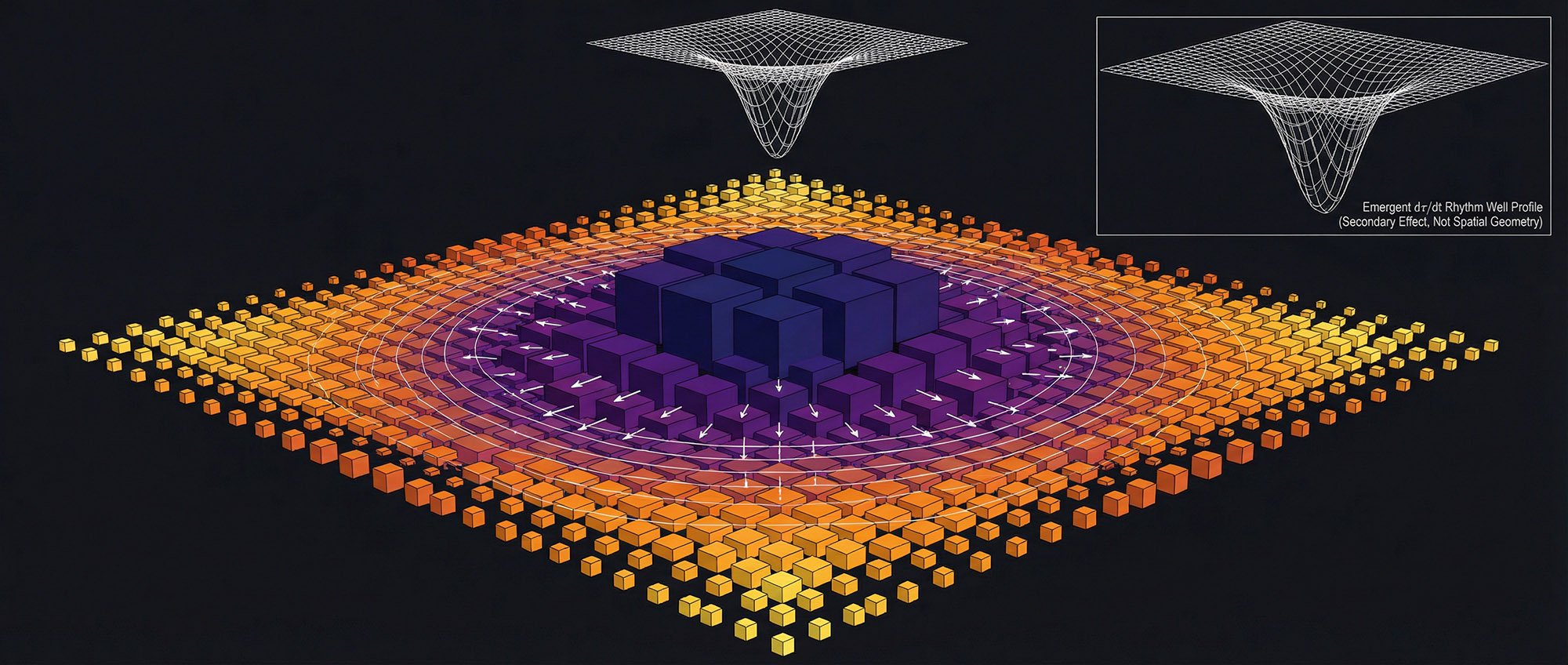
Phenomena such as gravity, mass, or the stability of matter are not primordial entities, but emerge from local information interactions.

The best example of emergence is gravity.
In the model, MĀYĀ is not a force or a curvature of spacetime, but the result of a local slowing of the rhythm of information updating. Where the complexity and "cost" of computations increase, the rhythm locally lengthens—and the gradient of this slowing between systems creates precisely what we observe as gravitational attraction.

The greatest discovery of the MĀYĀ Theory

The fine structure constant as an emergent necessity of information architecture

If reality is based on a computational architecture, then our existence becomes a rendering process—a stable image emerging from local updates of information in the Planckian network.
Space, time, matter, and the laws of physics are not primordial entities, but persistent patterns of synchronization in this discrete, pulsating substrate.

As information propagates through the planxel network, it must maintain phase coherence, suppress anisotropies, and stabilize long-range patterns — just like in modern 3D rendering engines, which maintain image smoothness and stability by constantly correcting data propagation.
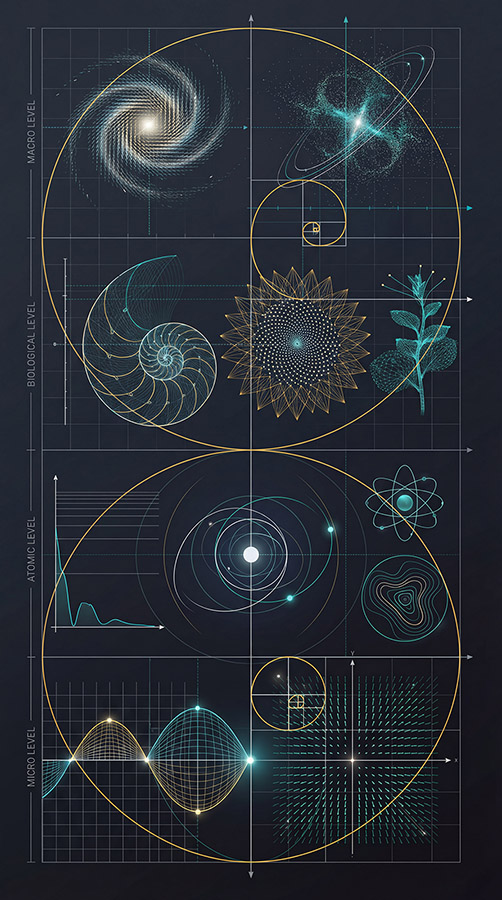
In nature, this role is played by the golden ratio φ: a universal pattern of optimization and stabilization that appears wherever systems strive for harmony.

In the Māyā Theory, the same mechanism operates at the basis of reality.
The requirement of a stable “rendering of the Universe” leads to the emergence of a fine structure constant α as a necessary parameter of information geometry.
This is not an arbitrary number, but the result of a fundamental architecture whose rhythm is determined by the proportion φ.

Why does perfect 137.5 become 137.036?
Because reality is not a perfect sphere: discrete geometry, anisotropies and subtle fluctuations correct the value resulting from pure geometry.
These micro-adjustments – forced by the network structure itself – reduce the ideal 137.5 to the stable value of 137.036 observed in the experiments.

$$
\boldsymbol{
\alpha^{-1} = \frac{360}{\phi^2}
– \frac{2}{\phi^3}
+ \frac{1}{3^5\phi^5}
+ \frac{7}{3^{12}\phi^{12}}
}
$$

It is the difference between a mathematical ideal and a physical reality that must compensate for its own discreteness in order for the world to exist in a stable form.

The fine structure constant – the biggest puzzle in physics for decades – finally receives an informational interpretation.

Be part of the revolution today that has the potential to change the world!

Co-create a new physics paradigm with us

MĀYĀ theory opens a completely new perspective on the nature of reality—as an information structure updated in the rhythm of Planck time.
ISKRA was created to bring together researchers, theoretical physicists, computer scientists, mathematicians, engineers, AI developers, philosophers of science, analysts, and enthusiasts who recognize the importance of this breakthrough and want to actively participate in it. It is a space for the encounter of different languages ​​of describing reality, in which interdisciplinarity is not an addition, but a foundation.

We combine interdisciplinary competences, create new models, develop publications, and build tools that can change the way we understand the Universe.

How can you help us?

  • co-create mathematical and physical models,
  • conduct analyses, corrections and scientific reviews,
  • create simulations of planxel dynamics,
  • prepare publications and scientific materials,
  • develop technology and computing tools,
  • support the institute's mission organizationally or financially.

Who is ISKRA for?

ISKRA is a space for all who want to approach the frontiers of knowledge. Both for those who professionally and scientifically engage with fundamental issues, as well as for those who think boldly, go beyond established patterns, and are ready to independently explore the nature of reality.

This is a place for curious minds, impatient with simple answers and open to new paradigms. For those who aren't afraid to question the structure of time, information, and consciousness, and for those who treat discovery as a creative process, not merely the reproduction of familiar ideas.

Join a project that can change how we understand reality!

Want more? Contact us.

Scientific research requires constant verification and dialogue.
We invite people interested in a substantive exchange of ideas, criticism and their own observations to contact us.

ISKRA INSTITUTE WARSAW/POLAND

Write to us!

    Cart (0 items)
    Address
    Warszawa
    Contact
    e-mail: contact@instytut-iskra.pl
    Working hours
    Mon - Sat: 8:00 AM - 6:00 PM Sunday: Closed