
- Preface
- The origins of the MAYA theory
- Problems of modern physics
- Why information?
- Planck units
- Planxel
- Physics implications of the planxel mechanism
- Reinterpretation of Formulas
- Time in the Māyā Model
- Space in the Māyā model
- Gravity
- Paradoxes of Physics
- ALPHA decoded
- Particles in MAYA
- Quantum mechanics
- Emergentna niezmienniczość Lorentza
- On the emergence of mathematics
Physics implications of the planxel mechanism
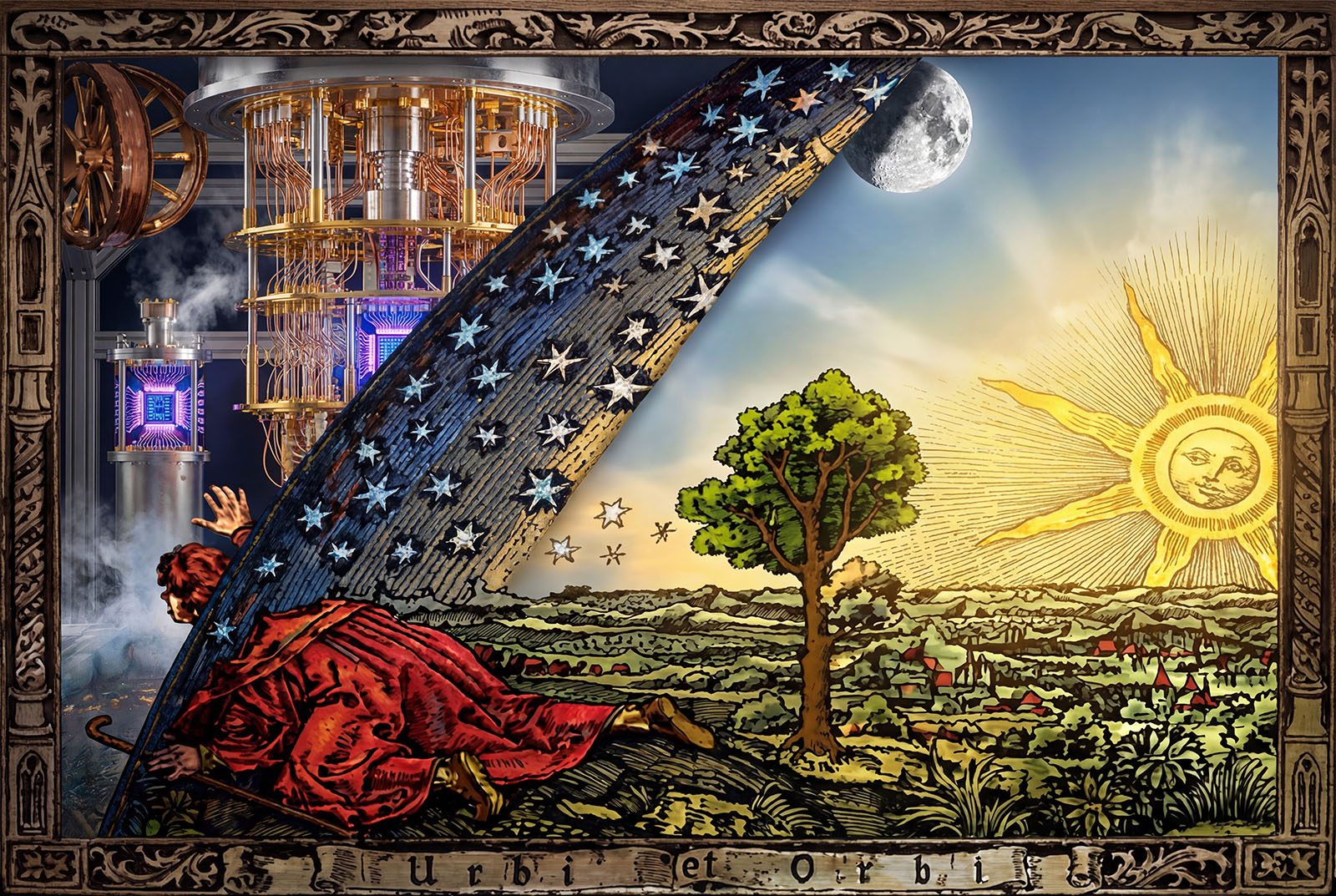
Reality as rendering
If the computational architecture of planxels is indeed the fundamental structure of the world – and more and more evidence suggests so – then the reality in which we operate is nothing more than an extremely advanced three-dimensional rendering.
Just imagine a computer screen. Individual pixels are static, discrete, and don't constitute any "object" in themselves. They are merely points with a specific state. Only when information flows through the entire grid of pixels according to simple rules does a continuous world emerge: movement, depth, space, relationships, and dynamics. An image doesn't exist in pixels—it exists as a process.
In the Māyā model, planxels fulfill precisely this role. They are elementary "pixels of reality": cubic cells with Planck-length sides, operating in the rhythm of Planck time. The grid itself is static and discrete, but the flow of information through it—local processing and synchronization—renders what we perceive as continuous space, time, and all the known laws of physics.
For centuries, physics has explored this very rendering, taking it as its foundation. Newton saw bodies moving in absolute space, Einstein the curved geometry of spacetime, and quantum mechanics probabilistic waves. Each of these descriptions concerned the image displayed on the "screen" of reality, not the rendering engine itself. It's like analyzing the world of a computer game, measuring the trajectories of objects and the force of gravity within it, unaware that everything is generated by simple rules operating at the level of pixels and the processor.
Māyā as an ontological reinterpretation of physics
The Māyā theory is not a theory that falsifies established physics. It does not negate known equations, does not alter the mathematical apparatus, and does not add additional ad hoc entities. It is an ontological reinterpretation of general relativity and quantum mechanics. The equations remain identical, the empirical predictions remain unchanged — but their meaning changes.
The key step is surprisingly simple: we stop treating the physical constants (c, G, ℏ) as primitive and arbitrary, and start viewing them as relations between Planck units—parameters of the computational architecture of reality. The speed of light becomes the quotient of elementary spatial resolution and elementary time cycle (c = ℓ_P / t_P), the gravitational constant becomes the relation between energy, space, and the maximum local processing load, and the Planck constant becomes the portion of the operation performed in a single cycle.
In this light, the same Einstein and Schrödinger equations begin to reveal the hidden mechanism: mass and energy as a slowing of the processing rhythm, time dilation as a lengthening of the local clock, gravity as a gradient in the synchronization rate, and particles as stable phase resonances.
From today's perspective, it's astonishing that we failed to recognize this possibility for over a century. Planck units appeared at the end of the 19th century, the geometry of spacetime was described at the beginning of the 20th, yet the language of information was lacking to interpret the same patterns in a new way. Only with our current knowledge can we see that the extremely small Planck scale can be interpreted not only as a barrier to cognition but also as a condition for perfect isotropy: synchronization with the full neighborhood in the cubic lattice, supported by phase dynamics, eliminates all distinguished directions, creating an impression of continuity and symmetry on the macroscale.
Particles as information solitons
One of the most profound consequences of this ontology is a new understanding of elementary particles. In Māyā, they are not material points or "spheres" moving through space. They are stable information solitons — self-sustaining patterns of phase resonance and synchronization, propagating through the network of planxels without loss of identity.
Like solitons in nonlinear wave theories, such structures maintain stability even after interactions. An electron, quark, or photon are not objects traveling in a pre-defined space — they are persistent patterns of information, and space itself emerges from their propagation. Mass results from soliton inertia, that is, from local overload of the processing rhythm. Charge is a phase asymmetry, and spin is a topological property of the synchronization pattern.
There is therefore no "particle transport" through space. There is only a transfer of resonance from planxel to planxel. Interactions are not exchanges of intermediary particles, but nonlinear adjustments to the rules of synchronization between patterns.
Profound implications for physics – eliminating paradoxes
Māyā not only reinterprets existing theories—it invalidates the ontological paradoxes of contemporary physics, rendering them artifacts of an erroneous material-geometric perspective. The most important of these is the problem of unifying gravity with other interactions:
- Gravity is not an interaction like any other – Unlike electromagnetic, weak, and strong forces (the exchange of quanta in fields), gravity is not a fundamental force or field. It is an emergent gradient of the processing rhythm in a network of planxels – a macroscopic effect of the collective slowing of synchronization. Therefore, it is the weakest, it sums collectively, and does not quantize in the classical way. The paradox of failed quantization of gravity disappears – gravity is simply not an elementary interaction.
- The End of Field Ontology – Fields (electromagnetic, gluonic, Higgs) do not exist as fundamental entities. They are merely averaged statistics of the synchronization patterns of the planxels. The quantum vacuum is not a physical "background" with real fluctuations—it is a region of minimal stress. The problem of the cosmological constant and vacuum energy disappears ontologically.
- Quantum without ontological randomness – Probabilizm mechaniki kwantowej nie jest cechą rzeczywistości samej w sobie. Jest epistemicznym cieniem równoległego, lokalnego przetwarzania – planxele działają bez globalnej wiedzy o całości, a obserwator widzi tylko statystykę wyników. Wszechświat nie „rzuca kośćmi”; paradoks Einsteina rozwiązany.
- The disappearance of the local observer – The observer is not a privileged physical entity. It is an emergent pattern of rhythmic correlations in the planxel network. Measurement is a local reconstruction of synchronization coherence; "collapse" is a transition to a single stable pattern. The paradox of the measurement problem disappears completely.
- Cosmology without a beginning in time – The Big Bang wasn't an event in time—time didn't yet exist. It was a phase transition in the global rhythm of the planxel network's execution. There's no "t=0," no question of "what came before." Expansion is a change in the synchronization relationship. Inflation and the initial singularity become redundant.
- The Singularities disappear – Black holes are regions of maximum load (ρ_max) where rhythm freezes – information is preserved holographically on the surface of the horizon. The information paradox in black holes solved.
- Dark Matter as an Effect of Long-Range Information Gradients – The phenomena attributed to dark matter do not result from the existence of invisible matter or new particles. They are the result of long-range information gradients generated by various interactions and physical processes in the planxel network. These gradients are not limited to regions containing baryonic matter—they extend far beyond it, and their contributions are superimposed in the surrounding network. On a galactic scale, this leads to the formation of extensive structures of persistent gradient recalculation rhythms, which manifest geometrically as gravitational halos. Therefore, galaxy rotation curves and gravitational lensing do not require missing mass but arise from long-range rendering dynamics.
- Dark energy as synchronization pressure in a planxel network – In the Māyā model, regions of low information density, such as cosmic voids, are characterized by a faster planxel computation rate than regions dense in information, where numerous interactions slow down local synchronization. This variation in rhythm is not a local artifact but a property of the global dynamics of the network. Because planxels must maintain coherence of execution across the entire Universe, the differences in computation rates between voids and dense regions generate a global synchronization pressure. This effect forces a reorganization of synchronization relations within the network and manifests itself geometrically as an accelerated expansion of space. Dark energy is therefore not a new physical entity or vacuum energy, but a macroscopic consequence of differences in the information processing rate within the planxel network, which maintains global rendering coherence.
Planxels as an unrendered execution layer
Ultimately, Māyā leads to another radical consequence: the planxels themselves don't exist within the rendered universe we experience. We only observe the emergent effects of their actions—space, time, matter, the laws of physics. Our theory suggests that planxels, as local acts of execution, belong to a higher layer of reality, beyond our rendering, just as the processor and game code exist beyond the world displayed on the screen.
Without this "external" layer, synchronization and global consistency would be impossible. This explains why we can't directly detect a discrete computational mechanism at the Planck scale—we're trapped inside the executing process. This isn't a limitation of the theory, but a necessary feature: rendering has no access to its own engine.
The reality we experience is not something that exists on its own. It is something that is constantly being rendered.
It's not just theory—it's a shift in perspective that makes physics coherent, minimalist, and ultimately mechanical. The rendering is so perfect that for centuries we mistook the illusion for substance. Māyā shows that behind the curtain lies a simple, discreet process.