
- Preface
- The origins of the MAYA theory
- Problems of modern physics
- Why information?
- Planck units
- Planxel
- Physics implications of the planxel mechanism
- Reinterpretation of Formulas
- Time in the Māyā Model
- Space in the Māyā model
- Gravity
- Paradoxes of Physics
- ALPHA decoded
- Particles in MAYA
- Quantum mechanics
- Emergentna niezmienniczość Lorentza
- On the emergence of mathematics
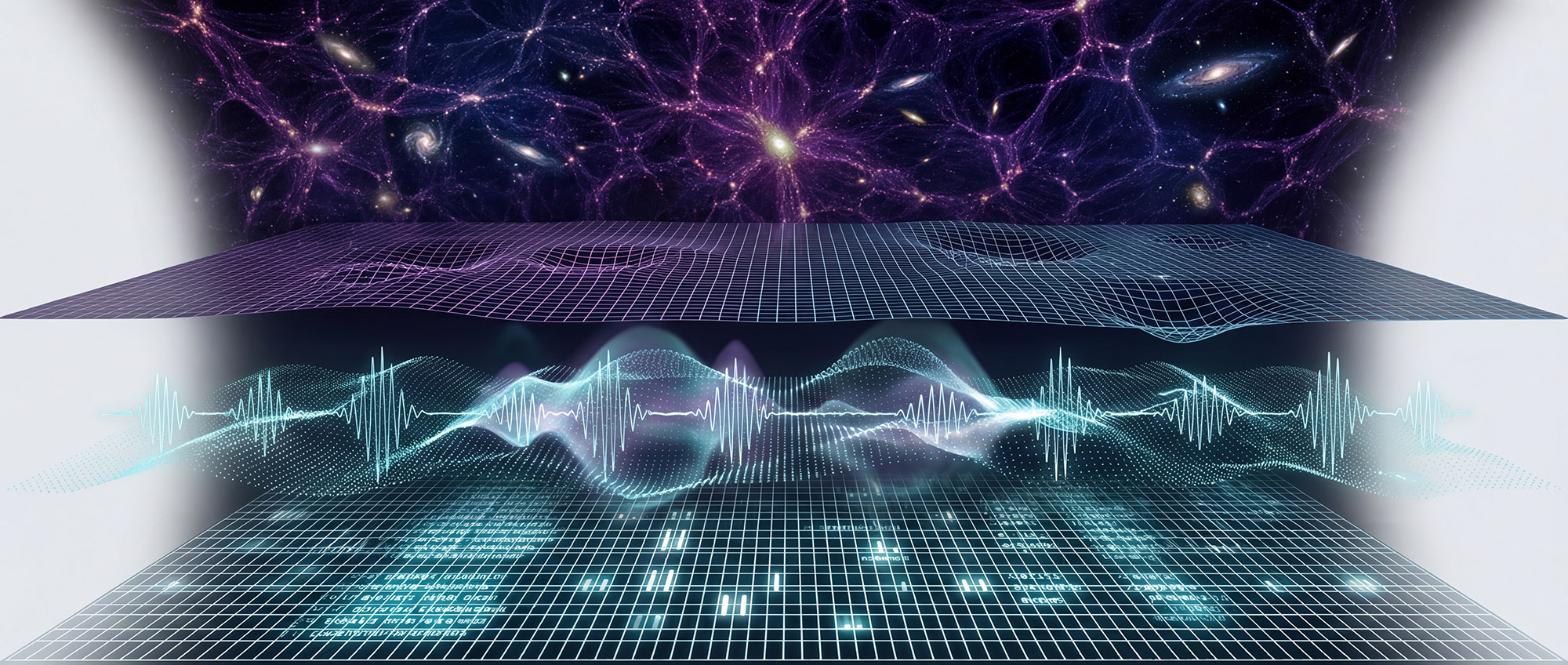
How space emerges from planxels
From Static Network to Emergent Continuity
In classical physics, space is a presupposition—an infinitely divisible, smooth, isotropic arena in which all events unfold. It is something that "already exists" before anything moves within it. Even in general relativity, where space becomes dynamic and curved, it remains a primordial entity—a continuum that can be deformed but whose existence requires no explanation.
In the Māyā model, space is not a presupposition.
Space does not exist before the planxels.
It emerges from the planxels.
A Planxel is not a "point in space" or a "small piece of matter." A Planxel is an elementary act of execution—a local, discrete information processor that, in each cycle of Planck time, performs a single, indivisible operation: it receives states from 26 neighbors, processes them according to a rule, stores a new state, and immediately begins another cycle.
The planxel matrix itself is static.
It's a simple, infinitely extending, regular lattice composed of cubic cells. Each planxel has six faces, twelve edges, and eight vertices—exactly 26 immediate neighbors. There's nothing fluid about it, nothing continuous, nothing "spatial" in the classical sense. There are only addresses, connections, and an update rule.
Planxels do not exist "in" this emergent space - they create it as an execution layer.
We only experience and study their rendering.
And it is from this absolutely static, discrete structure that emerges what we perceive as continuous, isotropic, three-dimensional space.
The mechanism of space emergence
Space in the Māyā model is not a primordial entity or a ready-made background – it emerges directly from the dynamics of the planxel network.
There is no "pre-made" space in which planxels can be placed. There is no void waiting to be filled, no pre-defined metric. The space itself is merely a set of adjacency relations between planxels. What we call "distance" is simply the number of synchronization steps required for information to pass from one planxel to another.
The planxel network is inherently cubic and discrete, which in classical geometry would suggest anisotropy—a preference for the x, y, and z axes and varying distances to neighbors (1 ℓₚ, √2 ℓₚ, √3 ℓₚ). However, in the Māyā model, information distance is defined topologically: for the processor, a connection to each of the 26 immediate neighbors has identical weight and costs exactly one synchronization clock. From the network's perspective, ℓₚ is not the length of the cube's edge, but a unit operating radius—a "step" of information that can reach any of the 26 neighborhood nodes in a single cycle.
If updating were limited to only six nearest neighbors (as in classical von Neumann automata), information waves would propagate much faster along the Cartesian axes than along the diagonals. Macroscopic space would then exhibit clear signs of a lattice: preferred directions, stepped wavefronts, and a lack of full rotational symmetry.
Māyā avoids this problem by using two interacting mechanisms that together ensure the full isotropy of emergent space – as smooth and symmetrical in all directions as we observe in reality.
The first mechanism is full 26-neighborhood. In each cycle, each planxel exchanges state with all 26 of its immediate neighbors (6 through walls, 12 through edges, and 8 through vertices). This allows information to propagate simultaneously in all possible directions of the discrete mesh. From the very first cycle, the wavefront is very close to the sphere – the velocity differences between directions are significantly reduced. Full 26-neighborhood acts as a basic, structural antialiasing layer.
The second mechanism is phase rotation by the golden spherical angle. The phase amplitude σ of each planxel shifts every clock cycle by an angle Δθ = 360° / φ² ≈ 137.507764°. The irrationality of φ means that the sequence never closes within a finite period. After thousands and millions of clock cycles, the phase propagation directions disperse quasi-uniformly across the entire directional sphere. Even the smallest residual preferences are converted into statistical noise—exactly as low-frequency sampling is used in advanced computer graphics to eliminate grid artifacts.
It is this mechanism—rotation around the golden angle—that is responsible for the value of the fine-structure constant α ≈ 1/137.036, considered one of the greatest mysteries of physics. The constant α is not an arbitrary parameter of electromagnetic interactions—it is a trace of optimal antialiasing of reality, necessary for a discrete cubic lattice to appear perfectly isotropic.
Both mechanisms work synergistically:
26-neighborhood ensures isotropy on short scales (in single timescales and local propagation), and the golden angle ensures isotropy on long scales (in long-term patterns, plane waves, and rotational symmetries). Together, they ensure that space, which at the Planck level is a rigid cubic lattice, becomes perfectly smooth, continuous, and isotropic in emergence—without any additional assumption of symmetry or imposed metric.
That's why we don't see the slightest trace of preferred cosmic axes in our universe, even though everything is fundamentally built from cubes. The renderer did its job perfectly—clock by clock, with 26 directions at once and a rotation of 137.5 degrees.
In a single Planck cycle, space is discrete—information can only pass to 26 neighbors at most. But in a single human measurement (e.g., 10⁻¹⁵ s), ~10²⁹ cycles occur. During that time, a wave or phase soliton pattern can pass through billions of billions of planxels. When averaging over this scale, the sharp edges of cubes, steps, and preferred directions are completely smoothed out. Continuity of space is therefore a statistical effect—just as a continuous image on a 4K monitor is an illusion created by billions of rapid changes in discrete pixels.
In classical physics, the ds² metric describes how "far" points are. In Maya, the metric is an emergent measure of the cost of synchronization.
When planxels in a given region are heavily loaded (high ρ), their local clock speed becomes longer (tₚ,eff > tₚ). To maintain phase coherence with their neighbors, information must "wait" longer for an update within a single cycle. The effective "distance" increases because this extended clock speed slows the signal propagation rate—information still passes one planxel per cycle, but each cycle takes longer. This is what we see as spacetime curvature in general relativity—radial space becomes effectively elongated, and the cost of traversing it increases.
Formally:
ds² = g_{μν} dx^μ dx^ν ≈ (local beat lengthening factor) · (dx)²
The curvature is therefore not a primary deformation of the continuum – it is the gradient of the extension of a single computational cycle in the planxel network.
Ontological note – perspective as a property of rendering
It's worth emphasizing another, often overlooked, consequence of this model. "Diagonal" is a concept belonging solely to the rendering level, not to the execution layer of reality. Planxels are not objects immersed in space and are not subject to any observer's perspective. There is no physical or logical procedure by which one can "look at planxels diagonally," because the very concept of gaze presupposes the existence of a pre-existing space and point of view—and these are the effect of emergence, not its cause.
A planxel is always a cube, regardless of how it is "represented" in emergent space, because its cubicity is not a visual feature but a topological structure of connections. On each "side"—if one can speak of sides at all—a planxel has an identical set of 26 neighbors, with whom it communicates in unison. Orientation, angle, or perspective do not exist at the level of the planxels; they are properties solely of the image of the world that emerges from their collective action.
What appears in the geometric description as distances of 1 ℓₚ, √2 ℓₚ, or √3 ℓₚ is merely a projection of Euclidean intuition onto the logical structure of the network. For the execution mechanism itself, there is only a single synchronization step, identical for each of the 26 neighbors. Space, angles, and diagonals appear only as statistical impressions of the rendering, not as elements of the computational architecture of the world.
Summary – Space as an Emergent Interface
In the Māyā model, space is not an entity.
It is an interface that emerges as a result of billions upon billions of local acts of synchronization in the network of planxels.
There is no "elsewhere" except the network of planxels.
There is no "distance" except the number of ticks needed to phase.
There is no "continuity" except the statistical smoothing of discrete steps by the golden angle and a huge number of iterations.
Space is an emergent effect so perfect that for thousands of years we mistook it for substance. Only when we look at it from the inside — cycle by cycle, planxel by planxel — do we see that what we considered the foundation of reality is simply the most beautiful side effect of code.
Rendering continues.
And the space – like an image on a screen – only exists while the update is in progress.
With each cycle.
With each rotation of 137.5 degrees.
With each phase closure.
Originality clause
Māyā theory does not claim primacy over the individual intuitions that constitute its picture of reality. The ideas of discreteness, the emergent nature of time and space, the informational nature of physical states, and the special role of the Planck scale have previously appeared in various contexts of theoretical physics, information theory, and the philosophy of science.
Māyā's originality lies elsewhere: in its first consistent treatment of known physics equations as descriptions of an execution mechanism, rather than merely formal relations or geometric structures. In this approach, Planck units serve as ontologically primitive parameters of reality's computational architecture, and physical constants — including the speed of light, Planck's constant, gravitational constant, Boltzmann's constant, and the fine-structure constant — emerge as resulting quantities encoding the relationships between resolution, clock speed, and local processing load.
Of particular importance is the new understanding of the fine-structure constant α, which in Maya theory is not a parameter of interaction strength or an empirically given number, but a parameter of stability and isotropy in spatial rendering. Its value stems from the necessity of applying irrational phase dynamics in a discrete, cubic planxel network and serves as an anti-aliasing mechanism, thanks to which a fundamentally discrete architecture can be perceived as continuous and isotropic.
Time is not a coordinate or backdrop for events, but a counter of completed local update cycles; space is not a geometric structure but an emergent interface rendered by a synchronization network; and isotropy and continuity of the world are not assumptions but stable outcomes of executive dynamics. Physical constants cease to function as inputs to the theory and begin to function as indicators of the system's performance at the level of macroscopic description.
In this sense, Maya theory does not propose new mathematics or new laws of physics. It proposes a shift in the starting point of ontology: from entities, fields, and geometry to process, execution, and local cycles of information processing. Its priority lies not in the discovery of new equations, but in revealing that known equations have long encoded the computational architecture of the world, without yet possessing a language to recognize it.