

The hydrogen atom as mechanical proof that α is a rendering parameter
The hydrogen atom is the simplest physical system, one in which all the foundations of modern physics converge: quantum mechanics, special relativity, and electromagnetism. It consists solely of a single proton and a single electron. It lacks charge screening, many-body correlations, chemical effects, collective structures, or any higher-order corrections. It is a limit system — one in which nature has nothing to be ashamed of and shows its cards in the purest possible form.
This is why hydrogen is not "just the first atom in the periodic table." It is the purest place where the fine-structure constant α reveals its real, structural meaning - not as an arbitrary empirical number, but as a parameter separating the discrete code from the observable image.
If α were an ordinary constant describing the strength of the electromagnetic interaction, its role in hydrogen would be one of many and unremarkable. However, the opposite is true: in the hydrogen atom, α occurs in its purest, geometric, and absolute form — without any masking effects.
Two scales that shouldn't meet - and yet they are separated by exactly 137.036
The electron has its own natural quantum-relativistic scale: the Compton wavelength
This is the minimum scale below which the electron can no longer be treated as a local particle – attempting further localization leads to the creation of electron-positron pairs and the collapse of the particle description. This is the raw resolution of the electron as a quantum entity.
On the other hand, the actual, observable size of the hydrogen atom – the Bohr radius – is given by the formula
This radius does not follow from any classical intuition. It results from a delicate balance between quantum blurring and Coulomb attraction.
Key mathematical fact – without any interpretive assumptions:
Exactly 137.036 (according to CODATA 2022: α⁻¹ = 137.035999206(11)).
At this point, someone might say: "So what? This is a mathematical identity – a₀ is by definition proportional to 1/α, so dividing by λ_C will always yield α⁻¹. It's like being surprised that there are 12 eggs in a dozen, because that's how we defined a dozen."
You're right – the relation is a tautology in the current system of units and definitions of constants. But the accusation misses the point.
Because physics does not explain why nature chose this numerical value 137.036 as the ratio of the two fundamental scales and not any other.
If α were different by one order of magnitude in either direction, there would be neither stable atoms, nor chemistry, nor long-lived stars, nor us asking this question.
- α ≈ 1/10 → unstable atoms, no chemistry
- α ≈ 1/1000 → bonds too weak, no structures
In other words: 137 is not an arbitrary definition. It is an extremely fine-tuned parameter that determines the very existence of the world as we know it. A dozen eggs is arbitrary. 137 is so non-trivially fine-tuned that physicists have been calling it the anthropically fine-tuned parameter for decades—and they can't derive it from any first principles.
So the question isn't, "Why is 137 in the definition?" The question is, "Why did nature set that slider to 137.036 — so that the world would be stable, isotropic, and habitable?"
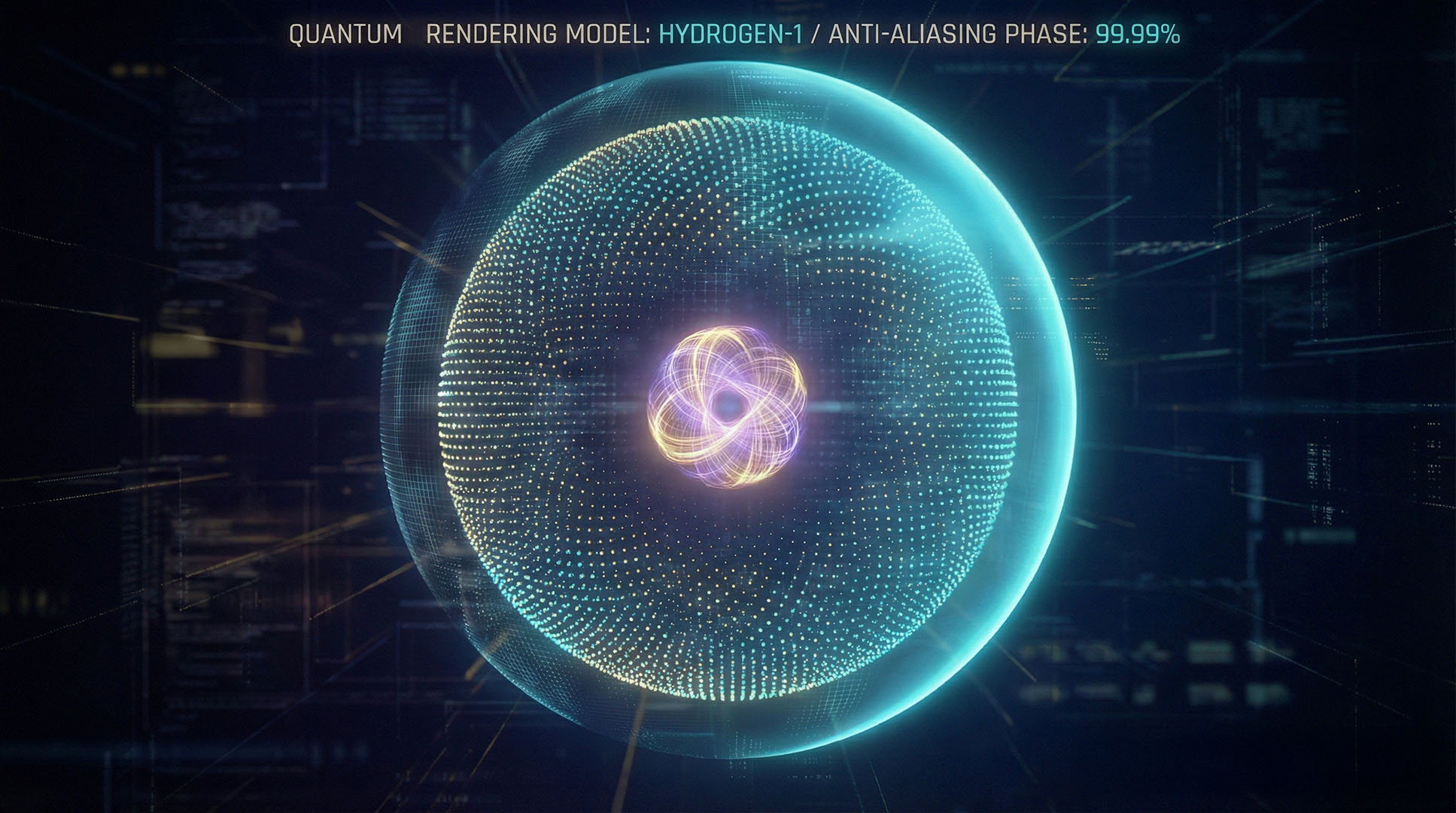
And this is precisely the question that perspective rendering provides the answer to: because it is the minimum buffer of samples / smoothing steps that allows hiding the discreteness of the Planck grid without blurring the atomic structure.
This is not an aesthetic metaphor, but a well-known algorithmic problem: generating isotropy and continuity from a discrete, anisotropic mesh with a finite computational budget.
What does this ratio physically mean?
This ratio doesn't describe "how strong" the electromagnetic force is in the ordinary sense. It says something much deeper and more structural:
how many times do you have to "move away" from the deepest quantum scale of the electron in order to create a stable, durable and observable atomic object.
In other words: α⁻¹ is a scale buffer – a minimal but sufficient number of steps that allows one to move from a harsh, discrete, relativistic reality to a stable, smooth structure.
The hydrogen atom isn't "one of many possible states" — it's the idle state of matter: the lowest possible stable energy level at which information doesn't collapse into quantum noise yet, yet doesn't require excessive maintenance costs. It's like setting the minimum voltage on a processor at which the system doesn't crash yet, but doesn't waste energy on unnecessary safety margins.
If the atom were of the order of λ_C, the electron could not exist as a stable pattern – the system would collapse relativistically (kinetic energy ≈ m_e c², not 13.6 eV). If it were much larger (α⁻¹ ≫ 137), the bond would be too weak to maintain the structure – Bohr radius → ∞, no atom.
The value α ≈ 1/137 places the hydrogen atom exactly between relativistic chaos and quantum blur.
This isn't a descriptive compromise. This is the system's operating point — the point at which discrete reality can generate its first stable structure without revealing its pixelated nature.
Rendering, not "Coulomb force"
The standard narrative is, "This follows from the Schrödinger equation and the Coulomb potential." This is formally true, but it is not a mechanical explanation.
The Schrödinger equation does not explain why the atomic scale is separated from the Compton scale by exactly α. It only encodes and utilizes this relationship.
However, if you look through the prism of discrete architecture rendering, the situation becomes completely transparent and mechanical.
A discrete structure (whether a grid of pixels in computer graphics or a hypothetical Planckian lattice) cannot directly generate smooth, isotropic structures. It needs a buffer — a number of steps, iterations, samples, or smoothing layers that "hide the pixels."
If the electron-nucleus distance were smaller (closer to λ_C), the system would not have enough "intermediate points" in the planxel lattice to calculate the spherical shape of the orbital. This is not about the literal geometry of the orbital, but about the statistical ability to reproduce isotropy with a finite number of local degrees of freedom. The atom would then have to exhibit clear anisotropic directions. Thanks to the 137 buffer, the planxel lattice is completely blurred by statistical averaging, giving the illusion of a perfect sphere – exactly as in our antialiasing or supersampling algorithms.
In signal theory, we call this the Nyquist limit: to correctly reconstruct a continuous signal from discrete samples, the sampling rate must be at least twice the highest component. In Maya, α⁻¹ ≈ 137 isn't just a buffer — it's deep supersampling: a 137-fold oversampling that ensures that the discreteness error ("pixelosis") is below the level of measurability (quantum noise). It's a safety margin that allows reality to appear continuous, even though it's discrete at the deepest level.
In computer graphics it's exactly the same:
- too small anti-aliasing buffer → visible jaggies, Moiré artifacts, pixelated nature,
- too large buffer → excessive blur, loss of definition and sharpness.
In the hydrogen atom we observe the same logic:
- too large α (strong coupling) → instability and state collapse (like too small a buffer),
- too small α → no permanent bond, fuzzy matter (like too large a buffer).
α⁻¹ ≈ 137 is a minimal but sufficient rendering buffer that allows hiding the discreteness of the Planck lattice at the atomic scale while maintaining a stable and sharp structure.
Why is hydrogen the limiting evidence?
In multi-electron atoms, the role of α is masked and blurred by charge screening by other electrons, many-body correlations, relativistic effects of heavier nuclei, and collective structure and chemistry. In hydrogen, none of this exists.
That is why in hydrogen we see the purest, most direct manifestations of the α-power hierarchy:
| Effect level | Scaling | Graphic equivalent (Māyā) | Physical result |
|---|---|---|---|
| Geometry | α⁻¹ | Mesh Resolution / Anti-aliasing | Atom size (a₀) |
| Stability | α² | Phase Sync / Frame Rate | Binding energy (13.6 eV) |
| Precision | α⁴ | Aberration Correction / High-dynamic range | Fine Structure (Lamb shift etc.) |
This is exactly the same hierarchy we see in rendering algorithms: first order – sample placement/geometry, second order – cost of maintaining temporal/phase coherence, higher orders – aberration corrections, motion blur, depth of field.
Hydrogen is a minimal unit test that shows that α is not a “strength of interaction” parameter, but a rendering level separation parameter.
The hydrogen atom as a boundary between code and image
This can be said even more sharply and precisely:
The hydrogen atom is the smallest "image" that can be rendered without revealing the pixels of reality.
Its size is not arbitrary. It is minimal, but still stable. It is the first structure that:
- does not reveal discreteness at the observable level,
- and at the same time it does not require any collective structures, shielding or emergent effects.
This is why 137 appears in hydrogen so cleanly, geometrically, and without any masking complications. Not because electromagnetism "works best there," but because that's where the rendering algorithm has to work for the first time—and it does so in the simplest way possible.
Conclusion
If α were just an empirical number, the hydrogen atom would be one of many places where it occurs – and that's it.
But if α is an execution instruction, then the hydrogen atom must reveal it as a geometric scale – and that is precisely what we observe.
The hydrogen atom is not indirect evidence. It is borderline evidence.
It shows that:
- there is a minimum quantum scale (λ_C),
- there is a minimum structural scale (a₀),
- and between them stands one single, absolute parameter: α.
Not as a "strength." Not as a "coupling." But as the cost of hiding discreteness — because in rendering and sampling technologies, the best such buffers come not from rational numbers, but from the class of extremely irrational numbers (golden angle and low-discrepancy sequences) that minimize correlations and artifacts — precisely the class to which the structure behind α belongs.
Therefore, 137 is not the secret of the atom. The hydrogen atom is the revelation of the secret of 137.
— because it is the first place where the code-to-image algorithm must work without any protections.
And the hydrogen atom is its certificate of consistency.
Rendering in progress.



![{"AIGC":{"Label":"1","ContentProducer":"MiniMax","ProduceID":"db91bded1c698d55894d1ef5eddd68de","ReservedCode1":"{"SecurityData":{"Type":"TC260PG","Version":1,"PubSD":[{"Type":"DS","AlgID":"1.2.156.10197.1.501","TBSData":{"Type":"LabelMataData"},"Signature":"9bb157ad7cbc65b4c1fa5690c84c9bdf5f0132c5ef94d72859de47f31d5e44790e6baf38838beebaf039c64331c0bab73e42a4b19662cca59badefbbbbc07b73"},{"Type":"DS","AlgID":"1.2.156.10197.1.501","TBSData":{"Type":"Binding","BType":"0"},"Signature":"e2dd7cd6e88cf05632e758d379924d5c8236a26c67745ad823d104d78cd64c5d8f8e374e97759c2461f990f936983a36cf0f9db27f46b2ba7d66cc5c6dc56c19"},{"Type":"PubKey","AlgID":"1.2.156.10197.1.501","TBSData":{"Type":""},"KeyValue":"00a0b3b0b6a0c9b0c89cab328342af4e8221ec5b40799cbe835ab4251f7b47e4fd"}],"Bindings":[{"Type":"Hash","AlgID":"1.2.156.10197.1.401","TBSData":{"Type":""},"Signature":"630dc4ca511d4f59f3f927c56122ba7f63e6044161c48c8c40e2682094241095"}]}}","ContentPropagator":"MiniMax","PropagateID":"db91bded1c698d55894d1ef5eddd68de","ReservedCode2":"{"SecurityData":{"Type":"TC260PG","Version":1,"PubSD":[{"Type":"DS","AlgID":"1.2.156.10197.1.501","TBSData":{"Type":"LabelMataData"},"Signature":"08ef883e4ba39de499f847827fb78f662b0520fd650447615ea92f16425ce999236d0259d5ee91be7fdbf851e45bc4618fc14b4faeb4360d28185e61def3adb3"},{"Type":"DS","AlgID":"1.2.156.10197.1.501","TBSData":{"Type":"Binding","BType":"0"},"Signature":"6eee946d865bd6007715bf2480af228df6edd8ca143955dc8f97e136e68ee0d90368522d58cd28cbbf01182192f740b00f76d65339806c263baff2c31e290e07"},{"Type":"PubKey","AlgID":"1.2.156.10197.1.501","TBSData":{"Type":""},"KeyValue":"00a0b3b0b6a0c9b0c89cab328342af4e8221ec5b40799cbe835ab4251f7b47e4fd"}],"Bindings":[{"Type":"Hash","AlgID":"1.2.156.10197.1.401","TBSData":{"Type":""},"Signature":"630dc4ca511d4f59f3f927c56122ba7f63e6044161c48c8c40e2682094241095"}]}}"}}](https://instytut-iskra.pl/wp-content/uploads/2026/01/alpha_wodor-166x166.jpg "alpha_wodor")