Is π always and everywhere ~3.14? Is a triangle always 180 degrees? Why do such abstract numbers and constants, seemingly invented by human creativity, even fit observations? We're accustomed to thinking that mathematics is a universal, "divine" language for describing reality. Māyā Theory says something different: Mathematics is a network controller —the technical specification of our specific "hardware." As I delved into the assumptions of my brother Seweryn's Reality Code Hypothesis, I began to wonder if this specification always has to be this way. Or maybe it will be different for different fundamental structures of reality? Maybe if we lived in a different universe, 2+2 wouldn't equal 4 after all?
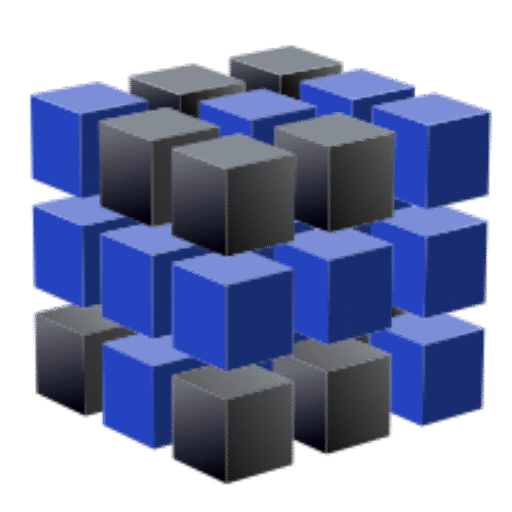
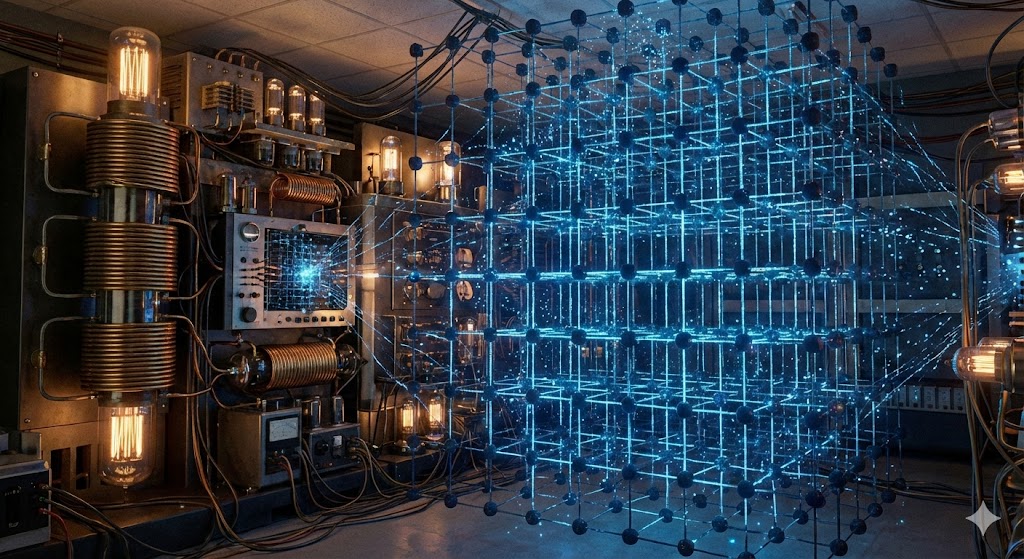
Modern physics seeks a "Theory of Everything," assuming that the laws of physics are immutable. We, at ISKRA, look at this from a different perspective and propose a radical hypothesis: Our Universe is a 3D matrix—a kind of giant quantum computer. This led me to the conclusion that other possible architectures exist. Other "computers," running different operating systems, generate completely different mathematics and physics.
Gallery of Universes: If Architecture Were Different
Imagine if an Architect (or Programmer) tested various network topologies before creating the world. What would life be like—and what mathematics would apply to them?
1. 1D Universe (Line) Architecture: A string of bits, one after the other. Math: There is only arithmetic. Geometry doesn't exist. π makes no sense. Life: Impossible. Information can't "pass." It's a world without complexity – like Pac-Man on a single line.
2. 2D Universe (Flatlanders) Architecture: Flat grid (hexagonal or square). Physics: Gravity weakens linearly (1/r), not with the square of the distance. There are no stable orbits – planets either fall into the star or escape into nothingness. Biology: A digestive system would divide the organism in two. You can't tie a knot.
3. Tetrahedral Universe ("Pyramid" World) Architecture: A network based on tetrahedrons, not cubes. Mathematics: A different packing of space. “π” would have a different value – the ratio of “circumference” to “diameter” would depend on the triangle jump metric. Chemistry: Based on angles of 60° and 120°. Our DNA and proteins presumably wouldn't be able to fold there.
4. Hyperbolic Universe (The Eternal Saddle) Architecture: More lines emanate from each point than in flat space. Mathematics: The sum of the angles in a triangle < 180°. Volume grows exponentially. Life: Impossible due to perfect solitude. A signal sent into space never returns. This is a universe where everything is instantly diluted.
5. The 4D Universe and Beyond (Hypercubes) Architecture: Hypercubes. Physics: Gravity weakens as 1/r³ – orbits are unstable. The slightest perturbation throws Earth into space. Evolution: Too many possible combinations. Chaos would presumably prevent stable forms from emerging.
Why is the Meta-Universe probably NOT discrete? If we assume that our world is a simulation on a discrete network, then intuition tells us: the "Creator's Computer" must also be digital. Except that would be a fatal performance error.
Every programmer knows: simulating a 3D world (e.g., Minecraft) inside another 3D world (a redstone computer in Minecraft) is horribly inefficient. You waste orders of magnitude of computing power.
Therefore, as I considered various possible constructions of the universe from which ours—quantum, computational—emerged, I began to consider another hypothesis: that the reality where the server that renders our world would reside could be fundamentally different. Then it hit me. Such a universe is CONTINUOUS—analog.
Meta-Reality: Where Paradoxes Are Law If the world "out there" is continuous (no pixels/voxels, no smallest unit of distance, beat, mass, energy), this explains the limitations of our world. We are a limited overlay on infinity.
What might such a Meta-Universe look like? From our perspective, it would explain why there are paradoxes that we can conceptually describe but which we don't observe in physical phenomena. The famous Banach-Tarski Paradox is their "powerhouse." Here, you can't create something out of nothing. But in continuous mathematics, you can cut a sphere into pieces and put them together to form two identical spheres. Here, that's impossible – we have elementary particles, quanta, and Planck units; you can't cut forever. An ultraviolet catastrophe could be real – and useful! Here, Max Planck "chopped" energy into quanta to avoid infinite radiant energy. There, light can be a real, continuous wave. Every second of that existence carries an infinite amount of information. As long as we can speak of seconds, because time either doesn't exist there or is nonlinear.Whereas for us, time is "processor clock speed"—counting successive cycles the length of Planck time—where computing power is infinite, all states exist simultaneously. Past, present, future are one "block" (Block Universe). Causality is blurred. What kind of consciousness would evolve in a world with access to true infinities? Our consciousness is sequential (thought by thought). Consciousness in the meta-universe would be parallel and total. It doesn't "think"—it knows.
Not a prison, but a sandbox So why do we live here, in a world of Planck pixels, gravity, and death? Perhaps continuity is too powerful. In a world where everything is possible, nothing is permanent, chaos reigns. To create stable history, love, art – limitations must be imposed. Our universe, in the theory of Maya, is a safe sandbox. We have been cut off from infinity by the Planck barrier. We live in a simulation not because someone is imprisoning us. We live here because in a limited, discrete, three-dimensional world, "I" is separated from "YOU."
Only here could an individual consciousness be born, one that asks: "Who am I?" Only here does mathematics have constant values. And the fact that π is 3.14159... and not 5.0 or 2.8? That's just a specification of our hardware. A hint that our reality has layers. That we are rendered.


![{"AIGC":{"Label":"1","ContentProducer":"MiniMax","ProduceID":"db91bded1c698d55894d1ef5eddd68de","ReservedCode1":"{"SecurityData":{"Type":"TC260PG","Version":1,"PubSD":[{"Type":"DS","AlgID":"1.2.156.10197.1.501","TBSData":{"Type":"LabelMataData"},"Signature":"9bb157ad7cbc65b4c1fa5690c84c9bdf5f0132c5ef94d72859de47f31d5e44790e6baf38838beebaf039c64331c0bab73e42a4b19662cca59badefbbbbc07b73"},{"Type":"DS","AlgID":"1.2.156.10197.1.501","TBSData":{"Type":"Binding","BType":"0"},"Signature":"e2dd7cd6e88cf05632e758d379924d5c8236a26c67745ad823d104d78cd64c5d8f8e374e97759c2461f990f936983a36cf0f9db27f46b2ba7d66cc5c6dc56c19"},{"Type":"PubKey","AlgID":"1.2.156.10197.1.501","TBSData":{"Type":""},"KeyValue":"00a0b3b0b6a0c9b0c89cab328342af4e8221ec5b40799cbe835ab4251f7b47e4fd"}],"Bindings":[{"Type":"Hash","AlgID":"1.2.156.10197.1.401","TBSData":{"Type":""},"Signature":"630dc4ca511d4f59f3f927c56122ba7f63e6044161c48c8c40e2682094241095"}]}}","ContentPropagator":"MiniMax","PropagateID":"db91bded1c698d55894d1ef5eddd68de","ReservedCode2":"{"SecurityData":{"Type":"TC260PG","Version":1,"PubSD":[{"Type":"DS","AlgID":"1.2.156.10197.1.501","TBSData":{"Type":"LabelMataData"},"Signature":"08ef883e4ba39de499f847827fb78f662b0520fd650447615ea92f16425ce999236d0259d5ee91be7fdbf851e45bc4618fc14b4faeb4360d28185e61def3adb3"},{"Type":"DS","AlgID":"1.2.156.10197.1.501","TBSData":{"Type":"Binding","BType":"0"},"Signature":"6eee946d865bd6007715bf2480af228df6edd8ca143955dc8f97e136e68ee0d90368522d58cd28cbbf01182192f740b00f76d65339806c263baff2c31e290e07"},{"Type":"PubKey","AlgID":"1.2.156.10197.1.501","TBSData":{"Type":""},"KeyValue":"00a0b3b0b6a0c9b0c89cab328342af4e8221ec5b40799cbe835ab4251f7b47e4fd"}],"Bindings":[{"Type":"Hash","AlgID":"1.2.156.10197.1.401","TBSData":{"Type":""},"Signature":"630dc4ca511d4f59f3f927c56122ba7f63e6044161c48c8c40e2682094241095"}]}}"}}](https://instytut-iskra.pl/wp-content/uploads/2026/01/alpha_wodor-166x166.jpg "alpha_wodor")