

Māyā as the Missing Piece of the Puzzle
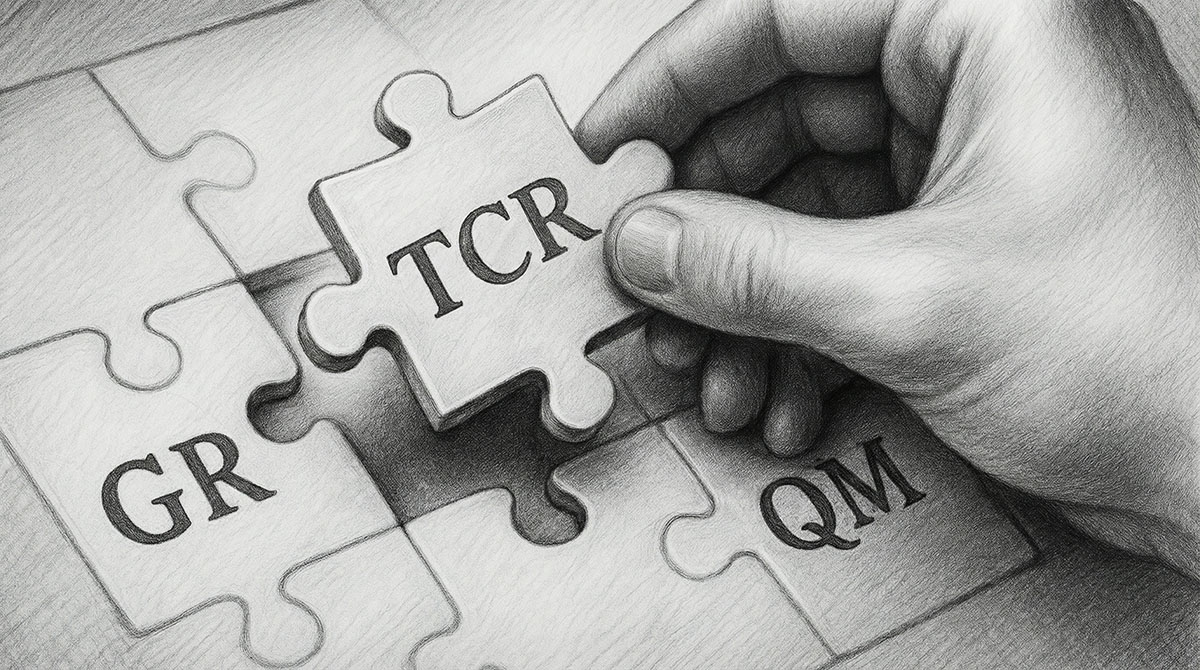
For a long time, I felt like physics was a puzzle in which almost all the pieces already existed. The equations were refined, the experiments were repeatable, the predictions were incredibly precise. Quantum mechanics worked, the theory of relativity, and cosmology did too. Each piece, taken individually, was nearly perfect.
And yet the whole thing never seemed to fall into place.
It wasn't about chaos or gaps in knowledge, but something more subtle: the feeling that the picture was almost complete, but still had a crack that couldn't be masked by further refinements. Paradoxes arose, and dark matter and energy emerged as necessary additions. Singularities were shelved under the label "limits of theory." The measurement problem in quantum mechanics was considered something we simply had to learn to live with.
Over time, it became increasingly difficult for me to believe that all this was the natural state of affairs. That the world, at its most fundamental level, must be so fragmented. That this long list of exceptions and caveats is not a signal that something is wrong, but the inevitable price of the limits of knowledge.
Breakthrough
The breakthrough wasn't the discovery of a new fact or a new equation. It was something simpler: a shift in perspective on what was already known. Māyā didn't emerge as another theory competing with existing ones. It appeared like a missing piece that suddenly allows us to see that all the other pieces fit together all along.
It was a very distinctive experience. Not a "eureka" moment, but a quiet, almost unsettling sense of certainty. Like when you find a puzzle piece you've been searching for for a long time and suddenly understand why you've been trying to force the other pieces together all this time.
Māyā doesn't change any of the fundamental equations. It doesn't correct Einstein or Schrödinger. It doesn't introduce new entities or additional fields. It only changes the ontology—the way we read what has long been written in the formalism. The equations cease to be descriptions of "things" and begin to look like descriptions of actions.
And it is at this point that something begins to happen that can no longer be ignored.
The illusion of randomness? Let's try to look at this honestly.
The first concern arises when you start plugging Planck units into the known equations—not as limits, but as architectural parameters.
The speed of light stops looking like a mysterious constant of nature and starts to resemble a purely technical parameter of the system:
One network step per clock. Nothing more. No metaphysics.
Planck's constant is revealed as the maximum portion of information processed in one cycle:
Newton's gravitational constant also loses its mysterious character:
And at this point something occurs that can no longer be considered a coincidence. The same three quantities — resolution, clock speed, and energy budget — return everywhere.
When you take the Schrödinger equation and substitute , quantum evolution stops being an abstract wave in space and starts looking like computational cost calculated in cycles.
When you do the same thing with Einstein's equations, the geometry of spacetime stops being "a curvature of space itself" and starts looking like the network's response to a local information load, scaled by exactly the same parameters.
This isn't just one case. These aren't two examples. This applies to the entire set of fundamental equations—from Dirac to Friedmann, from Hawking to Unruh. Each of them—when translated into Planck's language—reveals the same mechanism.
If we treat these equations as independent clues, the probability that they all "coincidentally" show the same architecture falls below:
And this is just the beginning.
A constant that not only fits, but without which the world would fall apart.
The most striking moment comes with a constant fine structure.
Its experimentally measured value is:
In Māyā, exactly the same number appears as a consequence of phase rotation by the golden angle in a discrete lattice:
The difference is about 3,×10-10—sixty times less than the measurement uncertainty. This agreement alone would be astonishing.
But this is no longer just about numbers.
If reality is, at its core, rendered—if it consists of a discrete, regular grid updated measure by measure—then an inescapable problem arises: mesh artifacts. Preferred directions. Periodicity. Anisotropy. Grid traces that betray a discrete substrate.
We face exactly the same problem in 3D graphics.
The only known solution that works stably over long periods of time is the golden angle—a rotation of about 137.5°. This angle maximizes periodicity, disperses correlations, and ensures ergodic phase mixing.
And exactly this same angle appears in physics as a fine structure constant.
This is not a metaphor. It is the same solution to the same problem—discovered once by physicists, once by engineers.
In this sense jest warunkiem możliwości świata renderowanego. Bez niej obserwowalna rzeczywistość nie byłaby gładka, izotropowa i stabilna. Zdradzałaby swoją siatkę.
And this is the point where the question "is it a coincidence?" loses its meaning.
When paradoxes disappear at once
At the same time—and this is crucial—paradoxes disappear. Not one. Not two. Entire groups of them.
- Measurement problem → the need to close the calculation cycle
- Peculiarities → network deadlocks
- Wave-particle duality → difference between the distributed and synchronized states
The uncertainty principle
reveals itself as an irremovable compromise of synchronization in a finite measure:
When they all solve themselves at once, it becomes clear that we're not dealing with a coincidence.
How much “luck” would have to happen at once?
Very conservative estimate:
- matching α → ~33 bits
- architecture revealed in equations → ~40 bits
- solution of ~20 major paradoxes → ~200 bits
- Rendering Engineering Compatibility → ~15 bit
- ontological minimalism → ~20 bits
- restoring intuition without changing formalism → ~15 bits
Total about 323 bits of coherence.
Probability of coincidence by chance:
In practice — zero.
Why this can no longer be "unseen"
This isn't proof in the strict sense of physics. But it's something equally enduring: hitting the right level of description.
Like any puzzle, when one piece is missing, it can take a long time to fix the others. But when that piece finally appears, the whole thing comes together effortlessly.
From this point on, it's difficult to return to the previous view of the world. Trying to "unsee" it is like arguing with logic: it can be done rhetorically, but not cognitively.
And we may have just begun to read the code that has always been written in equations—not as a story about what the world is, but as instructions for how to make it.
Conclusion: Reality as an Optimal Render
For centuries, we have sought answers to the question of the nature of the world in substance, then in fields, and finally in geometry. But at each of these levels, nature left traces that did not fit the picture of an "analog" universe.
Only today, armed with knowledge of systems architecture and computer graphics, are we seeing what has always been before our eyes. What we have formulated in the Maya theory is perhaps the most spectacular "duck test" in the history of physics:
If something walks like a duck, swims like a duck, and quacks like a duck, it is probably a duck.
If reality looks like a render, behaves like a render, and uses the same optimizations as a render, then it is a render.
Each of the pillars of modern physics turns out to be a "quack" of the same nature:
- The fine structure constant is nothing else than the anti-aliasing parameter (golden angle), without which the world mesh would be visible.
- The speed of light is the physical limit of the data bus clock speed (one planxel per cycle).
- Quantum mechanics is a phase-locked protocol that allows for flexible management of the state buffer before final write ("collapse").
- Gravity is an emergent effect of system time lag in areas of high process load.
This isn't "similarity." It's the identity of a mechanism. Physics no longer describes mysterious, supernatural forces, but rather the technical specifications of the interface we live in. Māyā is the moment when we stop asking "why does a duck quack?" and begin to understand the code that generates that quacking.
![{"AIGC":{"Label":"1","ContentProducer":"MiniMax","ProduceID":"db91bded1c698d55894d1ef5eddd68de","ReservedCode1":"{"SecurityData":{"Type":"TC260PG","Version":1,"PubSD":[{"Type":"DS","AlgID":"1.2.156.10197.1.501","TBSData":{"Type":"LabelMataData"},"Signature":"9bb157ad7cbc65b4c1fa5690c84c9bdf5f0132c5ef94d72859de47f31d5e44790e6baf38838beebaf039c64331c0bab73e42a4b19662cca59badefbbbbc07b73"},{"Type":"DS","AlgID":"1.2.156.10197.1.501","TBSData":{"Type":"Binding","BType":"0"},"Signature":"e2dd7cd6e88cf05632e758d379924d5c8236a26c67745ad823d104d78cd64c5d8f8e374e97759c2461f990f936983a36cf0f9db27f46b2ba7d66cc5c6dc56c19"},{"Type":"PubKey","AlgID":"1.2.156.10197.1.501","TBSData":{"Type":""},"KeyValue":"00a0b3b0b6a0c9b0c89cab328342af4e8221ec5b40799cbe835ab4251f7b47e4fd"}],"Bindings":[{"Type":"Hash","AlgID":"1.2.156.10197.1.401","TBSData":{"Type":""},"Signature":"630dc4ca511d4f59f3f927c56122ba7f63e6044161c48c8c40e2682094241095"}]}}","ContentPropagator":"MiniMax","PropagateID":"db91bded1c698d55894d1ef5eddd68de","ReservedCode2":"{"SecurityData":{"Type":"TC260PG","Version":1,"PubSD":[{"Type":"DS","AlgID":"1.2.156.10197.1.501","TBSData":{"Type":"LabelMataData"},"Signature":"08ef883e4ba39de499f847827fb78f662b0520fd650447615ea92f16425ce999236d0259d5ee91be7fdbf851e45bc4618fc14b4faeb4360d28185e61def3adb3"},{"Type":"DS","AlgID":"1.2.156.10197.1.501","TBSData":{"Type":"Binding","BType":"0"},"Signature":"6eee946d865bd6007715bf2480af228df6edd8ca143955dc8f97e136e68ee0d90368522d58cd28cbbf01182192f740b00f76d65339806c263baff2c31e290e07"},{"Type":"PubKey","AlgID":"1.2.156.10197.1.501","TBSData":{"Type":""},"KeyValue":"00a0b3b0b6a0c9b0c89cab328342af4e8221ec5b40799cbe835ab4251f7b47e4fd"}],"Bindings":[{"Type":"Hash","AlgID":"1.2.156.10197.1.401","TBSData":{"Type":""},"Signature":"630dc4ca511d4f59f3f927c56122ba7f63e6044161c48c8c40e2682094241095"}]}}"}}](https://instytut-iskra.pl/wp-content/uploads/2026/01/alpha_wodor-166x166.jpg "alpha_wodor")